
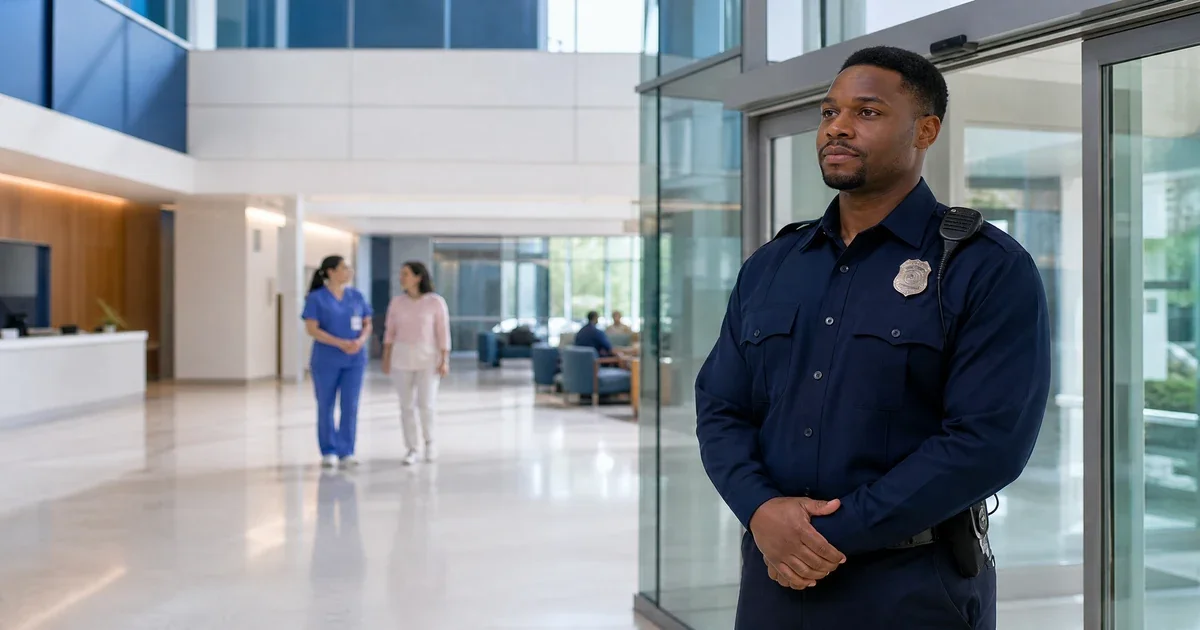
When you walk into a hospital, the last thing on your mind is safety. You are there for care, healing, or to support someone you love. Yet hospitals are among the most difficult environments in the world to secure. According to the Bureau of Labor Statistics, healthcare workers are five times more likely to experience workplace violence than the average U.S. employee. That number is sobering. It is also exactly why hospital security guards are far more than a visible presence. They are essential.
Security guards are the professionals who hold a complex, high-pressure environment together. Think about everything happening inside a hospital at any given moment. Patients in distress, families under enormous emotional pressure, staff working through exhausting shifts, and hundreds of visitors moving through the building. Managing all of that safely takes training, composure, and a sharp eye. If you have ever wondered what these professionals actually do during those long shifts, you are about to find out.
What Does A Hospital Security Officer Actually Do?
The role of these security officers goes well beyond standing at a front door. These professionals patrol the entire facility. They monitor corridors, waiting rooms, parking lots, and restricted areas throughout the day and night. They keep a close watch on camera feeds and maintain regular communication with medical staff to stay ahead of developing situations on the floor. It is a role that demands consistent focus and quick thinking at every hour.
A hospital security officer is also responsible for thorough documentation. If something appears out of place, they record it and relay the information immediately to the right people. That reporting chain is what stops minor issues from becoming serious incidents. Nothing gets overlooked when the system works the way it should.
Prevention Is At The Core Of The Job
Hospital security guards are trained to spot warning signs before a situation escalates. That might mean de-escalating a distressed family member in the waiting room, stepping in during a verbal dispute between visitors, or addressing someone who poses a direct risk to patients or staff. Their visible presence alone acts as a powerful deterrent to disruptive behavior.
This matters especially in high-volume emergency departments, where the pressure in the environment is intense. Effective security in hospital settings means having trained eyes on the floor at all times, people who know when to act and how to act without making a difficult situation worse. Understanding the difference between armed and unarmed security guards helps explain why healthcare facilities choose different security approaches based on their specific needs.
Armed And Unarmed Options In Hospital Security
Not every healthcare facility needs the same level of force. Some hospitals deploy hospital armed security professionals when the risk profile or location demands it. Armed officers carry service weapons and undergo specialized training, including active shooter response protocols. Most hospital security guards, however, rely on non-lethal tools such as batons, pepper spray, or TASERs, along with communication devices and body cameras to document incidents accurately. The tools match the environment. The training matches the stakes.
Qualifications That Define A Strong Hospital Security Guard
A high school diploma is the standard baseline for entry into this role. Beyond that, these security guards need training in CPR, emergency response, fire safety, self-defense, and conflict resolution. Many healthcare facilities require candidates to bring at least one year of prior security experience. Strong verbal and written communication skills are non-negotiable. Working in security in hospital settings means interacting with people at their most vulnerable, and that demands professionalism and composure at every level. American Shine Security holds every officer to these exact standards.
Security That Shapes The Patient Experience
Safety is an invisible but critical part of patient care. When patients, visitors, and staff feel secure, the environment supports healing. Security guards create that foundation. They enforce access control, assist lost visitors, respond to emergencies quickly, and address disruptive behavior calmly. Every action they take contributes to a safer and more functional facility.
Partner With Professionals Who Understand The Stakes
If you are looking for hospital security guards who bring both discipline and genuine care to their work, reach out to American Shine Security today. Their trained officers are equipped to handle the unique challenges of healthcare environments with the professionalism this setting demands. Let experienced professionals protect your facility, your staff, and every person who walks through your doors.
